
Catalunya 1400
The International Gothic Style
The Misfortunes of an Artistic Project
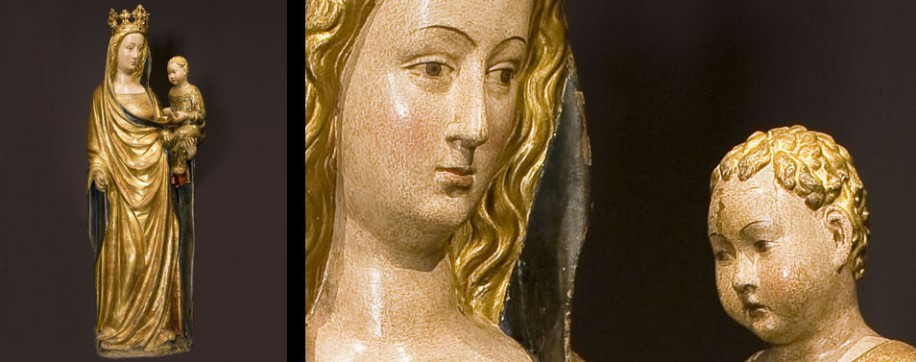
Madonna and Child
Attributed to Antoni Canet
Circa a 1402-1411
© Museu Diocesà de Tarragona
A sculpture in the middle of a painted retable
Originally, this carving of the Madonna and Child wasn’t an independent work. It was the titular image in the church of Santes Creus monastery, one of the most important Cistercian abbeys in Catalonia, where it presided over the high altar. It wasn’t the only sculpture on the retable, as at either end were the images of Saint Benedict and Saint Bernard, the Cistercian Order’s two principal saints, which were combined with eight painted panels arranged on two levels or registers. Each of these depicted one of the Joys of the Virgin, which is to say the joyful events in her life, from the Annunciation to the Dormition. The horizontal panel at the bottom of the retable, known as a predella, was also painted and was devoted to all the saints.
The misfortunes of an artistic project
The main retable of Santes Creus was one of the principal artistic projects undertaken in the days of Abbot Andreu Porta (†1404). It was probably in 1402 that Pere Serra, one of the most prestigious and experienced Catalan painters of the time, was summoned to do it. By then Pere Serra was a painter advanced in years who directed one of the most important workshops in Barcelona and, by extension, in the Crown of Aragon. He did so single-handed, as his elder brothers, Francesc and Jaume, who were also painters, had long since died. Unfortunately, though, soon after being given the job, between 1405 and 1408, the aged Pere Serra died, leaving the work unfinished.
This setback meant that the work had to be newly commissioned from another painter. On this occasion, the person chosen was Guerau Gener, who worked for such important centres in the Crown of Aragon as the cathedrals of Barcelona, Valencia and Monreale (Sicily). However, Gener’s unexpected death meant that in the end the retable had to be finished by Lluís Borrassà. One of a family of painters from Girona, Borrassà moved to Barcelona in the early 1380s and soon came to dominate the Catalan market in retables. Numerous artists worked and trained in his workshop, amongst them his Tartar slave, Lluc Borrassà, purchased in 1392, who came to play a prominent role there. More than 50 contracts for retables signed by Borrassà speak for the fructiferous activity of this leading workshop.
The three sculptures on the retable, for their part, were probably subcontracted to some sculptor by the painting workshop doing the work of the retable. Although the relevant documents have not survived, these carvings are usually attributed to Antoni Canet, from Empordà, one of the leading architects and sculptors of his day.
After 1400
After all these ups and down, in 1411, nine years after it was commissioned, the main retable of Santes Creus was complete and in place. Nevertheless, in 1647 a new retable was commissioned from Josep Tramulles, this time only with sculptures. By that time, the Gothic retable must have been seen by many as an old and unsuitable item of furnishing, hence the construction of the Baroque altarpiece, in line with the fashions of the time, which has survived in situ.
With the construction of the new retable, the old Gothic work was dismantled and moved to La Guàrdia dels Prats (Conca de Barberà). The carved Madonna and three of the columns of the retable of Santes Creus ended up in the parish church of Sant Jaume, while the remaining column was reused for the shrine of Santa Maria dels Prats in the same town. Today, the pieces of the retable from the shrine are kept at the Museu Nacional d’Art de Catalunya, while the rest of the panels and sculptures belong to the Museu Diocesà de Tarragona.
| Authorship | Attributed to Antoni Canet |
|---|---|
| Title | Madonna and Child |
| Date | Circa 1402-1411 |
| General classification | Sculpture |
| Material / technique | Polychrome and gilt carving in poplar wood. |
| Size | 202 x 67 x 48 cm |
| Work kept at | Museu Diocesà de Tarragona |